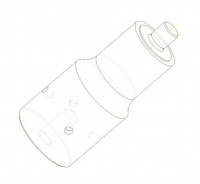
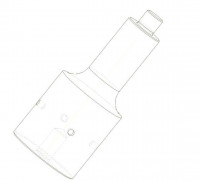
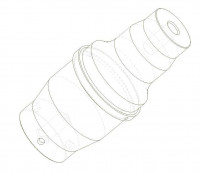
The ultrasonic boosters (amplitude transformers) determine the input amplitude at the sonotrode through their transmission ratio, which is usually between 1:1 and around 1:3. Our boosters are available for 20 kHz, 22 kHz, 30 kHz, 35 kHz and 40 kHz. mth supplies the appropriate titanium coupling screws for attaching the booster to the ultrasonic converter.
Boosters are available with or without a mounting ring. In the 40 kHz range, the entire oscillating unit is normally mounted on the converter housing. This is the case with many special machines, for example. Larger oscillating units for 20 kHz, such as those used in table-top welding machines, are held by a ring at the neutral point of the booster. This ring can either be floating or rotated together with the booster.
The transmission ratio
Depending on the design, the sonotrode has its own transmission ratio resulting from its geometry. This describes the ratio between the amplitude at the base point and the amplitude at the cutting or welding contour. In many cases, the transmission ratio within the sonotrode cannot be made sufficiently large, either because the diameters become too large or because the cross-sectional jump would lead to overloading of the material. In these cases, the amplitude can be increased using external boosters.
Before a sonotrode can be manufactured, the designer defines the contours based on the component geometry. Depending on the size of the workpiece and the material, the frequency is then selected and a CAD model is created using reference data. The finite element method (FEM) is then used to adjust the vibration behavior. This means that the model is modified until the vibration behavior is optimal in terms of both amplitude and uniformity. The CAM data for the machining center is then generated from the CAD model and the sonotrode is manufactured by machining the solid material.
Fault patterns and countermeasures
Sonotrodes are subject to wear due to material contact as well as thermal and mechanical loads. We have summarised some typical error patterns in this video.
General explanations about ultrasonic boosters
Ultrasonic boosters are crucial components in ultrasonic technology, as they amplify or attenuate the vibrations generated by the converter. This adjustment achieves the optimum vibration amplitude required for precise applications such as welding, cutting or sieving.
Together with other key components such as ultrasonic generators, ultrasonic converters, sonotrodes, and control units, boosters form a central unit in our ultrasonic welding machines. Thanks to their robustness, durability, and high efficiency, our boosters contribute significantly to reliable and high-quality welding results.
International presence through established business relationships
mth develops and manufactures ultrasonic solutions for individual industrial requirements. Long-standing business relationships ensure that ultrasonic components, hand-held welding equipment, and special-purpose machines are used throughout Europe and internationally.
mth offers ultrasonic converters for common frequencies such as 20 kHz, 30 kHz, 35 kHz and 40 kHz. The converter transforms the high-frequency alternating current from the ultrasonic generator into mechanical vibrations with amplitudes of approximately 5–12 µm.
All generators have standard functions for time-controlled and energy-controlled welding. With time-controlled welding, the ultrasonic output is automatically stopped after the preset time and the energy output is displayed.
For more than two decades, we have been manufacturing sonotrodes in-house for various ultrasonic systems from different manufacturers suitable for common applications such as welding, cut-off welding, riveting, embossing, punching and cutting.