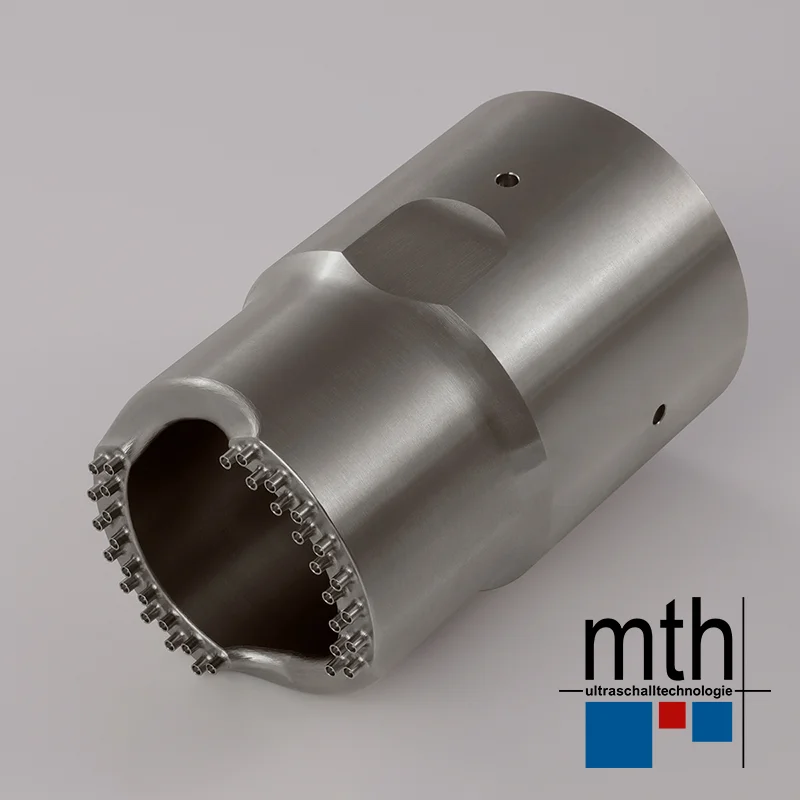
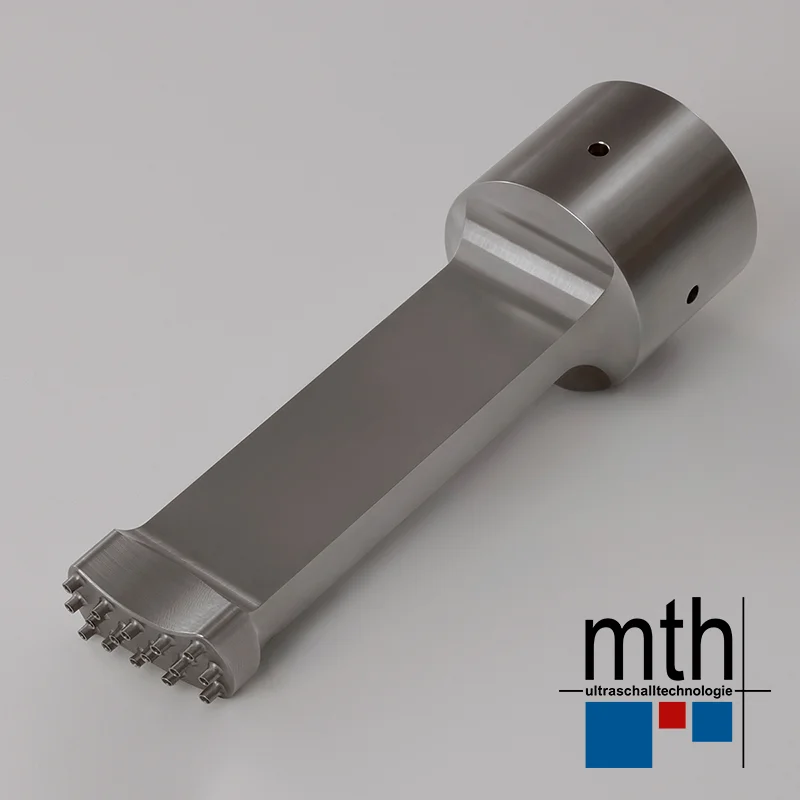
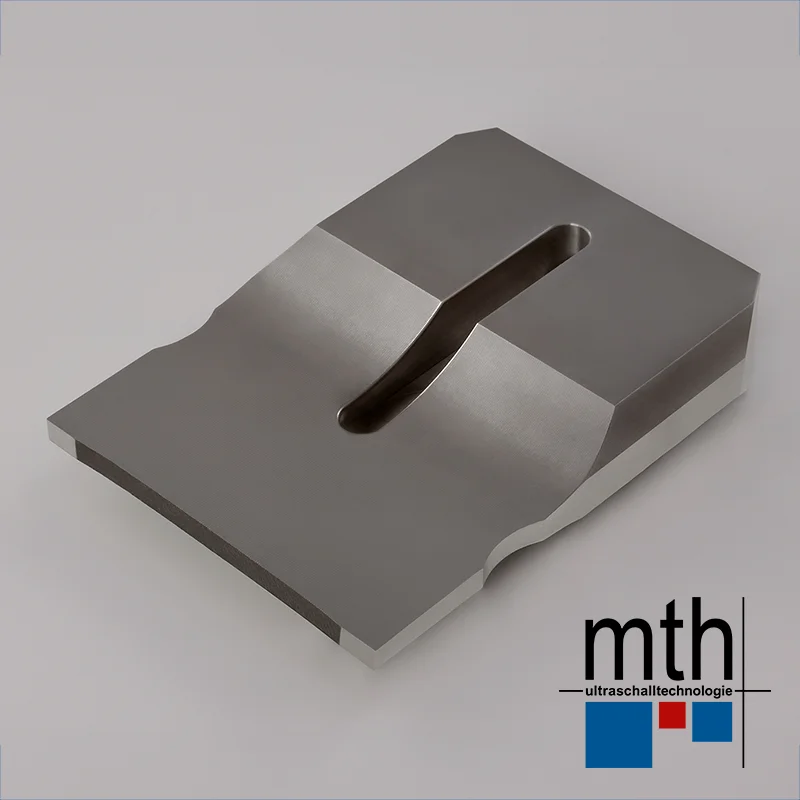
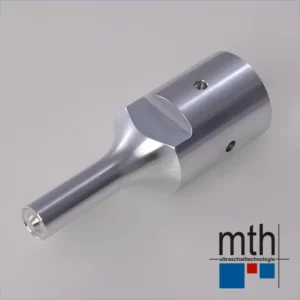
sonotrodes

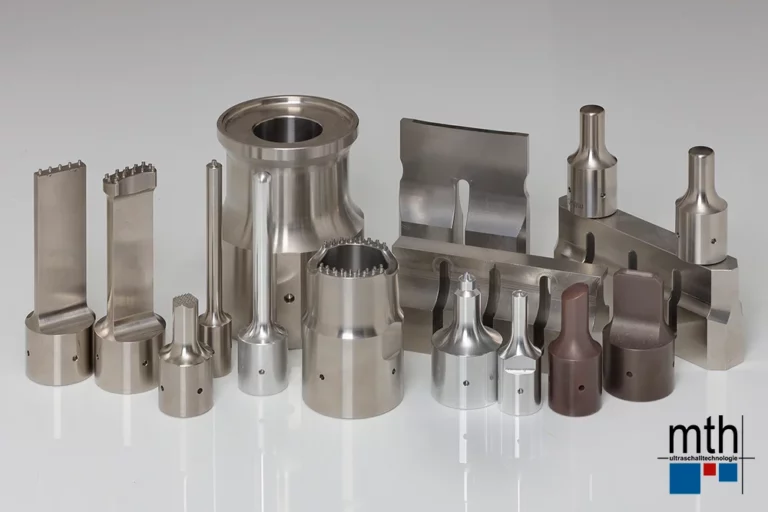
mth Ultraschalltechnologie has been manufacturing sonotrodes independently of manufacturers for more than 2 decades. From design to final production, we offer complete in-house manufacturing of sonotrodes for a wide range of ultrasonic systems from different manufacturers and with all common application functions. These include welding, cut-welding, riveting, embossing, punching and cutting.

Since our inception, we have manufactured approximately 20,000 different sonotrodes for a wide range of applications. We keep a small stock of standard sonotrodes in our warehouse for urgent emergencies. In our archive, we have access to a large number of design drawings, and our servers contain various CAD data for sonotrodes. This enables us to respond to customer enquiries promptly and relatively cost-effectively.

In our online shop, we show you a small selection of examples for different applications.

We manufacture sonotrodes according to your requirements and needs.

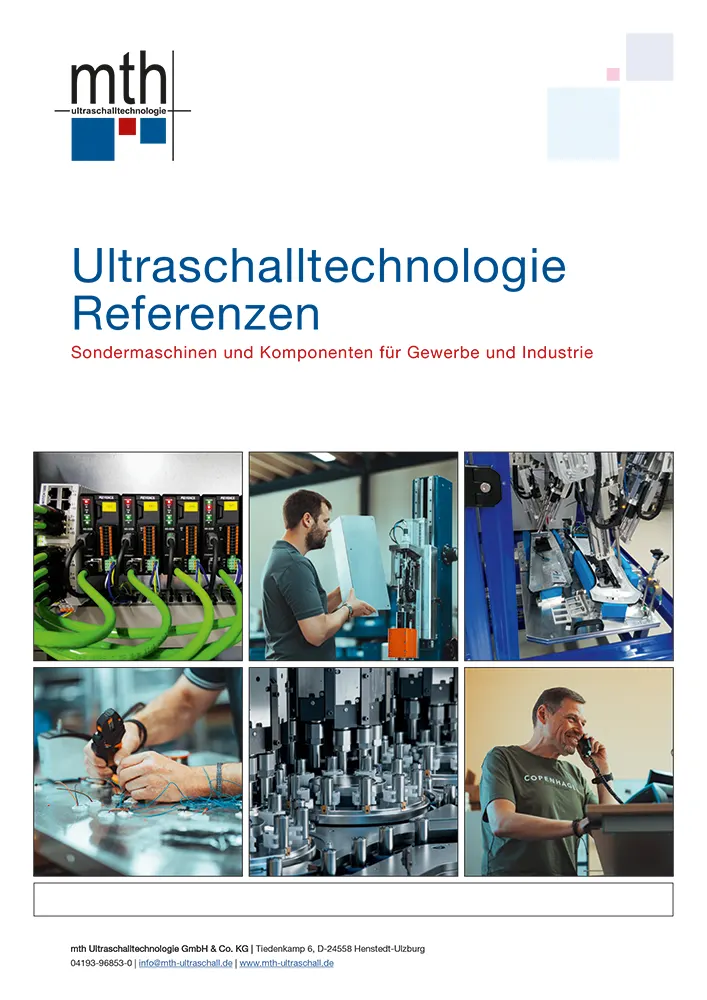
Our references for industry solutions

Are you looking for solutions for precise plastic connections?

In this brochure, we show you how industry leaders in the automotive, medical technology, packaging, and industrial sectors are already successfully relying on special-purpose machines from mth Ultraschall.

Get special insights into the possibilities of ultrasonic welding!

Materials for sonotrodes

In addition to the geometry, the correct choice of material is decisive for the longevity of a sonotrode. mth designs and manufactures sonotrodes with the appropriate material depending on the application.

  • Aluminium alloy sonotrodes: Aluminium is primarily used for large-volume sonotrodes and those with high heat dissipation requirements. Aluminium can be coated with a hard anodised layer to reduce wear.
  • Titanium alloy sonotrodes: Titanium is the standard material when it comes to more complex contours and long service lives. Surface hardening is also possible with titanium.
  • Sonotrodes made of tool steel: Hardened steel is required if workpieces with a high fibre content or (partially) chrome-plated workpieces are to be welded.
  • Sonotrodes made from other materials:Other materials and specific surface finishes are available on request.

Sonotrode types

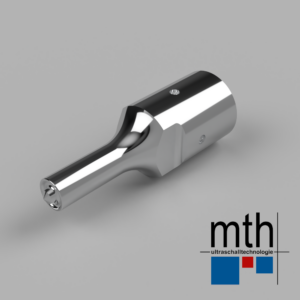
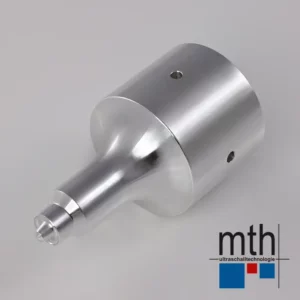
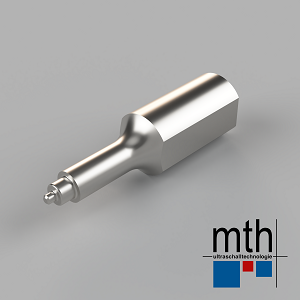
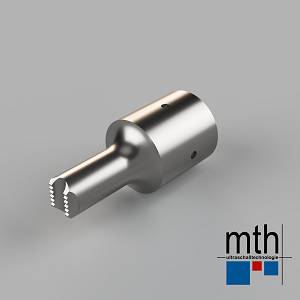
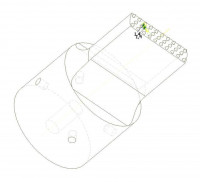
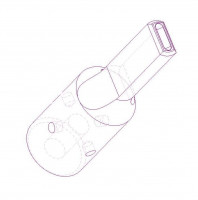
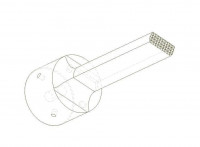
We manufacture the following types of sonotrodes for various applications: round, knife, block, spot, needle, bar, piercing and fakir sonotrodes.

Product range of mth ultrasonic sonotrodes

How is a sonotrode manufactured?

Before a sonotrode is manufactured by us, our design department determines the contours based on the component geometry. Depending on the size of the workpiece and the material, the frequency is then selected and a CAD model is created using reference data.

The finite element method (FEM) is used to adjust the vibration behaviour. This means that the model is modified until the vibration behaviour is optimal in terms of both amplitude and uniformity. The CAM data for the machining centre is then generated from the CAD model and the sonotrode is manufactured by machining the solid material.

Fault patterns and countermeasures

Sonotrodes are subject to wear due to material contact as well as thermal and mechanical loads. We have summarised some typical error patterns in this video.

Function of the sonotrode

The sonotrode is the link between the welding system and the workpiece. It transmits the vibration energy of the ultrasonic system, ensures the amplitude transformation and transfers the contact pressure of the machine to the workpiece. We manufacture sonotrodes and the necessary Booster after analysing the customer’s requirements in detail, both for standard tasks and for individual ultrasonic applications. mth supplies the appropriate titanium coupling screws for attaching the sonotrodes to the ultrasonic converter .

General explanations about sonotrodes

Sonotrodes play a crucial role in ultrasonic technology. They are in direct contact with the workpiece and transfer both the ultrasonic energy and the necessary contact pressure directly to the material. Their overall shape and the contact point with the workpiece depend on your individual task: welding, cutting or sieving.

Other essential ultrasound components that are directly related are: ultrasound generators, ultrasound converters, ultrasound boosters, feed units and the control system. These components are used in our ultrasonic welding machines in a particularly compact and durable design.

International presence through
established business relationships

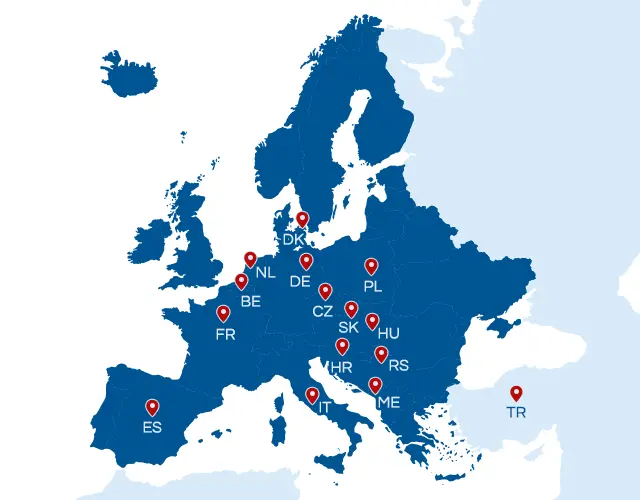
mth develops and manufactures ultrasonic solutions for individual industrial requirements. Long-standing business relationships ensure that ultrasonic components, hand-held welding equipment, and special-purpose machines are used throughout Europe and internationally.

Do you have questions?

We are happy to help you individually with all questions relating to the manufacture of sonotrodes:

Information on the use of sonotrodes and associated components

Types of sonotrodes

Shapes and applications

Each type of sonotrode is designed and manufactured by us in accordance with the requirements of the specific application. There are a large number of different types, which are derived from the shape, function, material, structure or application.

Structure of an ultrasonic welding machine

The components

An ultrasonic welding machine consists of a variety of components: the ultrasonic generator, the welding unit consisting of an ultrasonic converter, ultrasonic booster and sonotrode. Further details can be found on the following page.

Advantages of ultrasonic welding

The innovative joining technology

Ultrasonic welding is an advanced welding and joining technique. This technology uses high-frequency sound waves to join materials. This article highlights how ultrasonic welding works, its advantages and its future.

Ultrasonic converter

Variety of ultrasonic converters

mth offers ultrasonic converters for common frequencies such as 20 kHz, 30 kHz, 35 kHz and 40 kHz. The converter transforms the high-frequency alternating current from the ultrasonic generator into mechanical vibrations with amplitudes of approximately 5–12 µm.

Ultrasonic boosters

Our ultrasonic boosters

The ultrasonic boosters (amplitude transformers) regulate the input amplitude at the sonotrode using a transmission ratio of usually 1:1 to around 1:3. Our boosters are available for 20 kHz, 22 kHz, 30 kHz, 35 kHz and 40 kHz.

Ultrasonic generators

Energy-efficient welding

All generators have standard functions for time-controlled and energy-controlled welding. With time-controlled welding, the ultrasonic output is automatically stopped after the preset time and the energy output is displayed.